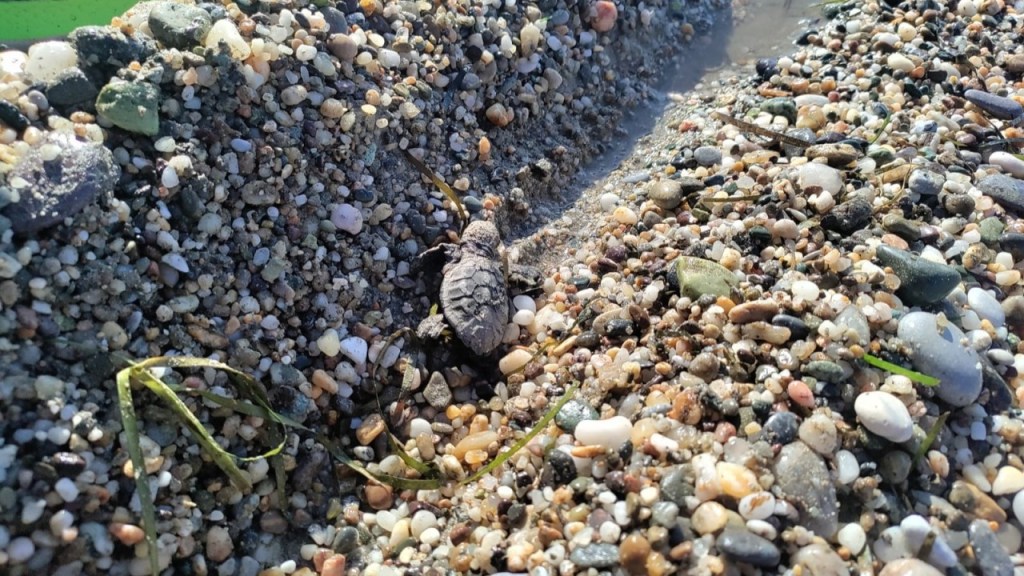
This month I volunteered for the protection of loggerhead turtles (Caretta caretta) in Greece for 3 weeks. Here are my reflections on conservation, human behaviour and behavioural design.
There was a lot of tourist activity and infrastructure on the 5 turtle nesting beaches in the south Peloponnese, where I worked. Humans pose problems for sea turtles, but now they can actually be the solution!
Let´s look at the whole system and nail down some of the key threats to their survival:
Lights from restaurants and hotels during the night
Most local businesses do not turn off their lights during the night and some can be very bright. Emerging baby turtles get disoriented and sometimes follow the opposite direction, heading into town instead of the sea. This threat can be mitigated with “shading”, an installation with mostly natural materials to prevent hatchlings from going towards the lights and guide them to the sea instead.

Stray and semi-stray dogs
I call them semi-stray, because these are dogs that run around and hang out regularly at a place, but they do not belong to anyone. Unfortunately, these are the most common case of strays. Even if some locals feed them and give them names – they tend to deny any responsibility: “this is not my dog”. Stray dogs run around unconstrained, they dig out nests and destroy turtle eggs. Luckily, the metal grid that you see in the photograph above, protects turtle nests from curious dogs, stray or not. It allows baby turtles to come out, but prevents digging. However, it does not protect the babies from being eaten at night by a dog, at the exact moment they come out (apparently this happens despite the fact that the semi-stray dogs have already been fed earlier!).
Foxes and other wild animals
Foxes are smarter predators than dogs. If nests can be protected with a grid installation, then most dogs are no longer a threat (at least for the eggs). But foxes often do figure out a way to dig and get the eggs – sometimes under the grid. They also seem to be checking all the nests regularly one by one – based on the tracks they leave at night! In other locations, wild boar are the strongest predator– no nest protection design can defer them, because they just throw the grid away with their tusks. But here they are less common and pose less of a threat, mostly appearing in wild beaches and areas without any human activity.
Beach equipment: sunbeds, surf boards, boats and so on
People tend to leave all sorts of stuff on the beach overnight and they become obstacles for baby turtles, when they emerge from the sand and try to reach the sea. Also such obstacles can prevent mother turtles from laying their eggs in the first place.
Some business owners pack their sunbeds during the night, keep dogs inside – but others do not. Expensive resort owners have installed some rather heavy sunbed installations that cannot be moved at all during the season. Everybody has been informed about the required policies, their obligations that come with running a tourist facility in a Natura 2000 protected area. Those include removing and stacking sunbeds, tables, chairs and umbrellas from the nesting zone for the night. Therefore, “awareness” or “education” is not what is missing here. Those who do not change their practices, feel no pressure to do so. Like in so many places around the world, there is no local law enforcement – the only government office is far too far away and under-resourced.

So what are the motivating drivers of those who do change?
Here are some for you to reflect upon:
- A sense of pride for having these rare sea turtles in their back yard…
- Wanting to be perceived as a responsible and sustainable business…
- Feeling responsible for protecting the environment they operate in, it´s their future after all…
If you were about to design a new program, how would you apply these drivers to create a behaviour change strategy?
Humans are the solution. Here is why.
Surprisingly, predation is so high on wild beaches – where many displaced wild animals find their way to feed on the nests – that hardly any baby turtles even make it to sea to start their journey. Many of us have this image in our minds – from nature documentaries – of baby turtles emerging from the sand en mass in the wild, all at once, while being preyed upon by seagulls and other animals. But this phenomenon is actually quite rare! What normally happens is that a few turtles come out from a nest on one night (it could be just one or it could be 10, it really depends) and then they keep coming out on the following nights, for about a week. As they tend to emerge in small numbers, it is easier for predators to pick them up, before they make it to the sea.
But near local communities, beaches have more tourists, but less wild animals preying on turtle eggs and hatchlings. So baby turtles can actually have a better chance of survival near people – but with the right measures in place and the right attitude. So there is an opportunity for greater impact, if more business owners and tourists adopt a caring mindset and a sense of responsibility towards these precious animals.
In the field of conservation, behaviour change is associated primarily with communication campaigns.Communication campaigns alone however, are not enough to shift mindsets towards conservation. Studies have shown that social marketing has a success rate of up to about 7% in influencing people´s behaviour – for example in the case of wildlife trade. In other areas, healthcare in particular, we find more advanced examples of behavioural design – tools and services that support and guide people in making better choices. My volunteering experience presented an interesting case study for designing alternative interventions.
What if your behaviour change strategy was more than a communication campaign? What would it be?
Do you have any program design examples that encouraged local business owners to change existing habits and adopt new practices for environmental conservation? (e.g. like in this case, removing beach equipment in the evening, reducing light pollution and keeping dogs inside or on a leash during the night). What worked well? Do you know of any failures? We need to learn from failures too!

This short article was originally published on LinkedIn on 25/09/2024


Leave a Reply