The “Service Design For Good” framework
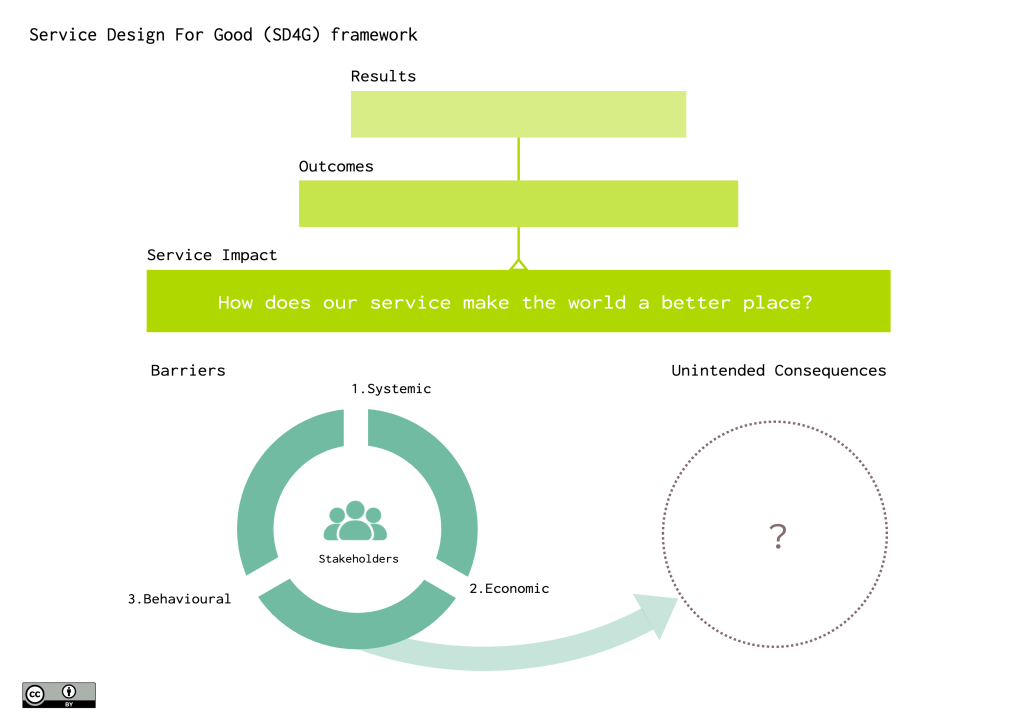
The “Service Design for Good” (SD4G) framework is for service designers who want to help their teams move from good ideas towards meaningful, impact-oriented services. Effective design tools usually come from the field — and the SD4G framework stems from our hands-on research and design experience across diverse humanitarian, healthcare, and environmental international NGO projects. It bridges service design with systems thinking and while its roots are in the non-profit world, its value extends beyond it.
What does it serve for?
- Help teams align on a shared impact goal before ideation
- Surface unintended consequences early in the design process
- Map systemic, economic and behavioural barriers across key stakeholders
- Incorporate progressive, measurable impact in service innovation
The template
You can download the SD4G framework template in PDF format to use for a design workshop, where you co-create services that drive change with your team. The template can be applied to a wide range of industries, including healthcare, transportation and tourism.
Workshop guidelines
A few tips on how to plan and run an effective multi-stakeholder workshop with the SD4G template:
1. Workshop planning
This exercise is meant to provide input for the ideation and prototyping phases, for a novel service or an existing one that you are trying to improve. Start with a draft statement about the positive impact that your service is trying to achieve. You can include this in your workshop invite, then validate and refine it with the participating group, as needed. Consider:
How does the service benefit people, the environment or culture?
Participants
Invite key stakeholders to the workshop. Make sure that both the person within your organisation who is most familiar with customer needs and challenges (e.g. user or behavioural researcher) and the main decision maker (e.g.product owner, innovation lead or founder) – can join the session.
Materials
To prepare for the workshop, collect any insights you might have about your target customers and service partners. Review your service design deliverables to extract those, such as research reports, ecosystem and stakeholder maps, personas etc.
Walk through the components of the framework and add 1-2 examples for each, prior to the workshop. If you discover that you are struggling to identify examples and feel that there are knowledge gaps (e.g. around potential behavioural barriers that your target customers might have), then it is best to delay the workshop until you get additional research insights to guide you. If you don’t have any primary data, you can look for any available secondary research or perform expert interviews within your organisation to fill in those gaps.
2. Workshop facilitation
Depending on the scope of your project, you can run this as single workshop or break it down in a few separate sessions, particularly if additional research is needed or stakeholder alignment on the desired service impact proves to be challenging. It is crucial to define the “service impact” goal (1) to start the process – at least as a draft statement. Then complete the rest of the key components with your group, while ensuring that you capture diverse perspectives from everyone:
Key Components

1. Service Impact
Start with a well defined service impact statement. One which answers the question: “How does our service make the world a better place?” Here is an example from a healthcare project: “Our digital service helps early stage diabetes patients to make the necessary lifestyle changes with the goal to revert or control their chronic condition”.

2. Barriers
Map systemic, economic and behavioural barriers for key stakeholders. Key stakeholders in this context are both customers, partners and service providers. For example, if your service is a marketplace, you need to consider potential barriers for all participating groups. This is where your supporting research material and service design deliverables come in handy.

3. Unintended consequences or effects
Create hypotheses around potential unintended consequences or effects on these stakeholders. What could happen, if certain barriers are not addressed? How might this service affect communities and nature? Identify those effects that pose a high risk.

4. Results & Outcomes
Finally, define long-term outcomes and short-term results that would deliver the desired impact, but also anticipate the unintended effects of the service in the system it operates. Timeline definitions will vary, depending on the industry, but for short-term results consider metrics for the first pilot implementation.
3. Input for the design process
Look at the workshop output and consider the design implications for the service. What strategies do these barriers and potential unintended consequences require?
How might we turn the challenges into opportunities? What kind of design solutions could we introduce to address them?
Remember to follow-up on any knowledge gaps that might have been identified through the workshop. Know “what we do not know“.
You can now start ideation and service prototyping!
The SD4G framework in SDN’s Touchpoint magazine
(CONTENT TO BE ADDED LATER…. a photo of the print publication and the final 50 word abstract with link to online article here)



 design follows insight