In a recent article, we discussed how prompt engineering is creating another digital divide that goes beyond literacy, particularly when creating content with AI. Since we do not have a clear “conceptual model” for AI, language alone is not sufficient as a means of interaction. Snippets of useful content are often fragmented across multiple iterations – but regardless the prompt – we can’t quite get it right. But what if we could somehow build this conceptual model? What if we could better understand how LLMs collect, synthesise and create content? I tackled this challenge with some conceptual sketches.
Before we can figure out a new, and much needed, human-AI interaction paradigm, we first need try to make the invisible visible:
How might AI map human knowledge in a way that we can understand, validate and question it constructively?
So here are some “what if” design concepts, visualisations of a future LLM. These sketches represent interactive visualisations that are LLM-agnostic and as such are aspirational for future, more human-centred design directions for AI.
Concept sketch 1: Chrono
A map of how topics, perspectives and ideas change over time
Ask AI a big question and you a long list of sub-topics or ideas. But what’s valid? Where did the information come from? Does the answer consider past perspectives? How far in our knowledge do these topics go?
What if – AI could give you a map of what it found. Not a longer answer, but a picture of the territory: which ideas exist, how they connect, and how well they are backed up with evidence.
The Chrono concept sketch, with reference to “χρόνος” which means time in Greek, shows a timeline that works like a landscape. Wide stretches mean lots of content volume on a given topic, and narrow ones mean little. The colour coding is used to cluster information sources that represent the same topic, or similar ideas. Imagine that you could use this to see how a particular perspective or a theory is formed over time.
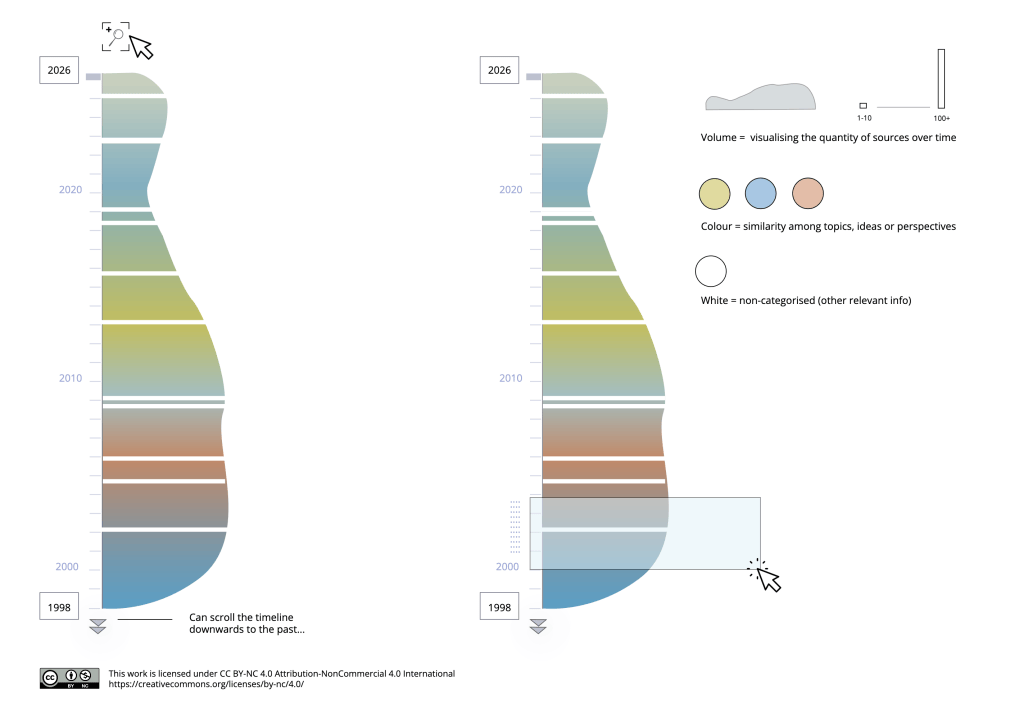
Chrono: a vertical timeline of content found and organised by AI
Zoom into any part of the timeline and you can see the evolution of knowledge, how a particular topic or perspective changes with growing evidence.
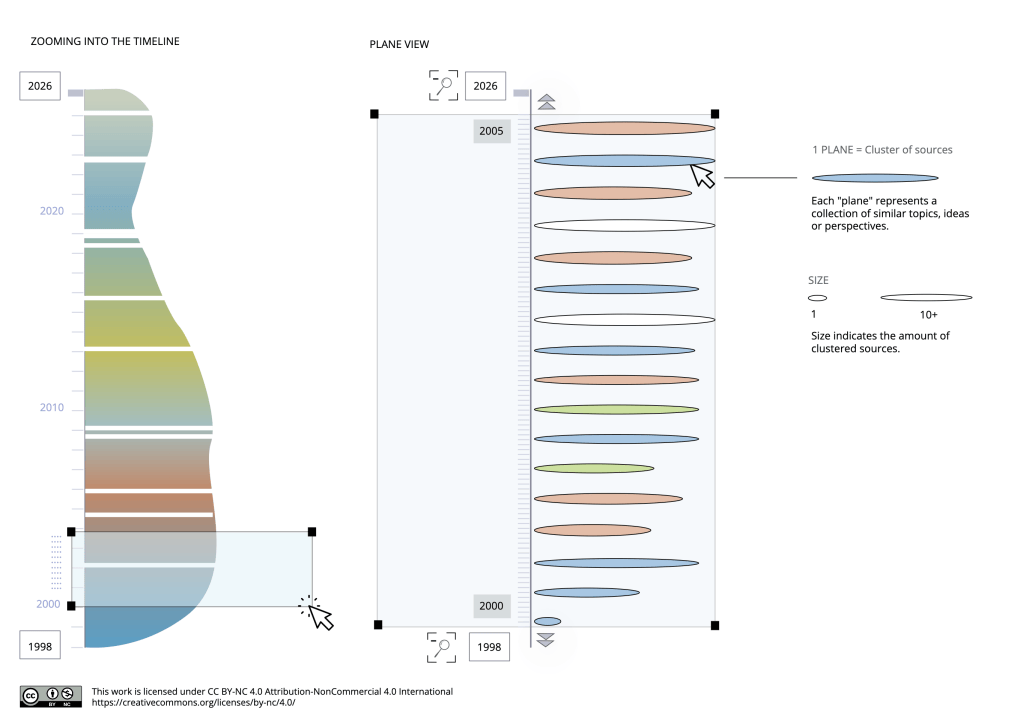
Concept sketch 2: Path Diversification Tree
A map of dynamic pathways that you can actually shape & question
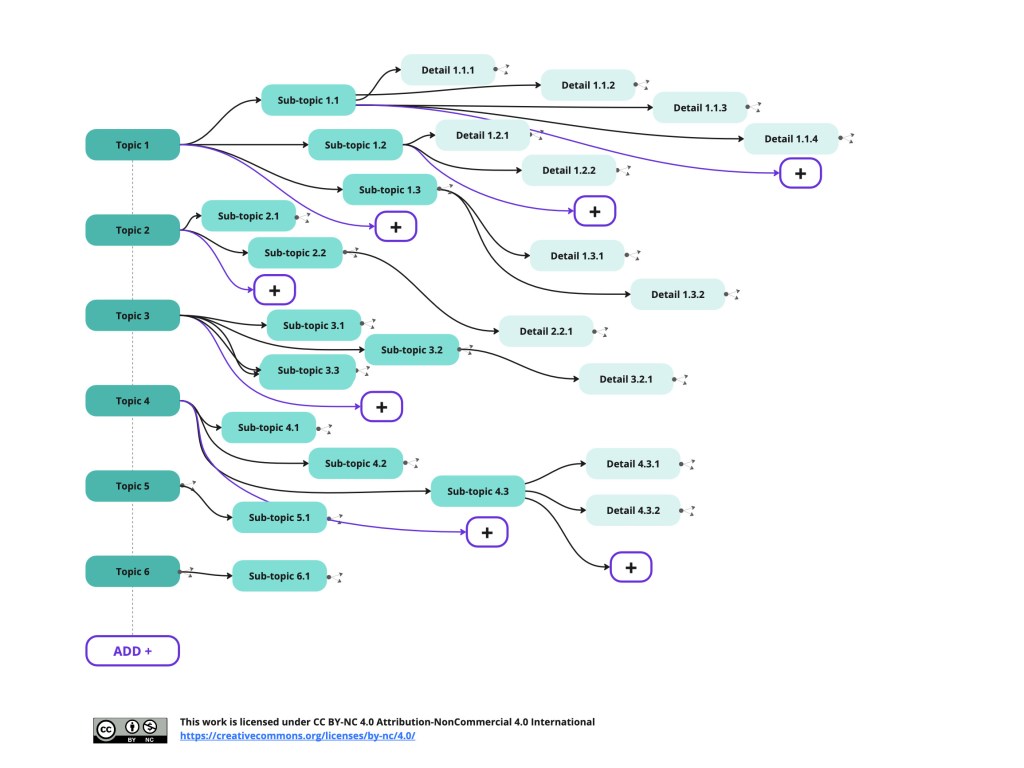
Today, when LLMs break a broad topic into subtopics, this content mapping is built by AI alone, and as a user you follow one path at a time. As you prompt, trying to cover more ground while checking various sources, you suddenly find yourself lost, with dozens of tabs open. We have all been there. But what if you had more control over your prompting and thinking, creating new paths as you go and deep diving at any point and at any of these paths you want?
In the Path Diversification Tree concept sketch, humans regain agency and shape AI generated content. Each query is less of a “black box” and more of a dynamically co-created workflow. In each step, a human can create a diversion by introducing new input, pull-up evidence with sources and explore contradicting ideas or perspectives. Instead of passively consuming AI output, we could actively inject topics or subtopics “in context” within the tree visualisation, automatically triggering the AI to propose relevant knowledge for those new topics.
Finally, let’s zoom into the detail. The idea here is that we select a piece of information to work with – in a dedicated space – perhaps in a panel on the side of the tree visualisation. Imagine if we could use this piece to:
- Verify: AI looks for sources globally that support the statement.
- Expand: AI searches for related ideas, content and more detail.
- Contradict: AI looks for contradictory arguments or ideas.
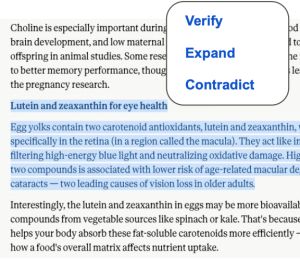
Each of these actions would also create a new, smaller pathway – a branch in the tree visualisation.
Why this matters
Every emerging technology goes through a phase of unknowns, just think of the first mobile phones with touchscreens that were invented in the early 00s. New tech requires a process of R&D: designing prototypes, experimenting and plenty of trial and error. Human-AI interaction is at that stage today.
If tech companies could get this right, the benefits go beyond convenience, narrowing the divide between expert AI prompters and everyone else. It is time to bring agency back to the person: you decide where to dig, what to question, and what to keep, rather than prompting your way through an AI-driven thread. As these concepts are model-agnostic, they could shape how many different tools work in the future. But they are only a starting point.
To actually build these as interactive visualisations for AI models, design and AI engineering would need to prototype them together, just like we once had to figure out how to make the first touchscreen phones more intuitive for people. As an interaction designer who has always worked on the frontier of emergent technologies – I would love to be part of that conversation.
Less prompting. More thinking.
————————————————–
Please read this
These high-level designs are meant as an inspiration for envisioning AI-driven visual knowledge tools that empower and support human creativity and thinking. If anything here inspires a new idea, direction, visual component – something that proves to be useful for your tool’s AI user experience (AIUX) – please acknowledge the author’s contribution.
Besides, acknowledgement, we would love to hear about your project!
These designs have been created by Yanna Vogiazou and are licensed under Creative Commons BY-NC 4.0.


Leave a Reply